Research Framework
Human communication is one of the brain's most complex and fundamental functions. Every conversation requires the seamless integration of multiple neurobiological systems including sensory, motor, cognitive, affective, predictive, and autonomic systems that enable us to perceive, interpret, produce, and adapt communication in constantly changing environments. At the NeuroComm Lab, we investigate how these interacting systems give rise to successful human communication across the lifespan.
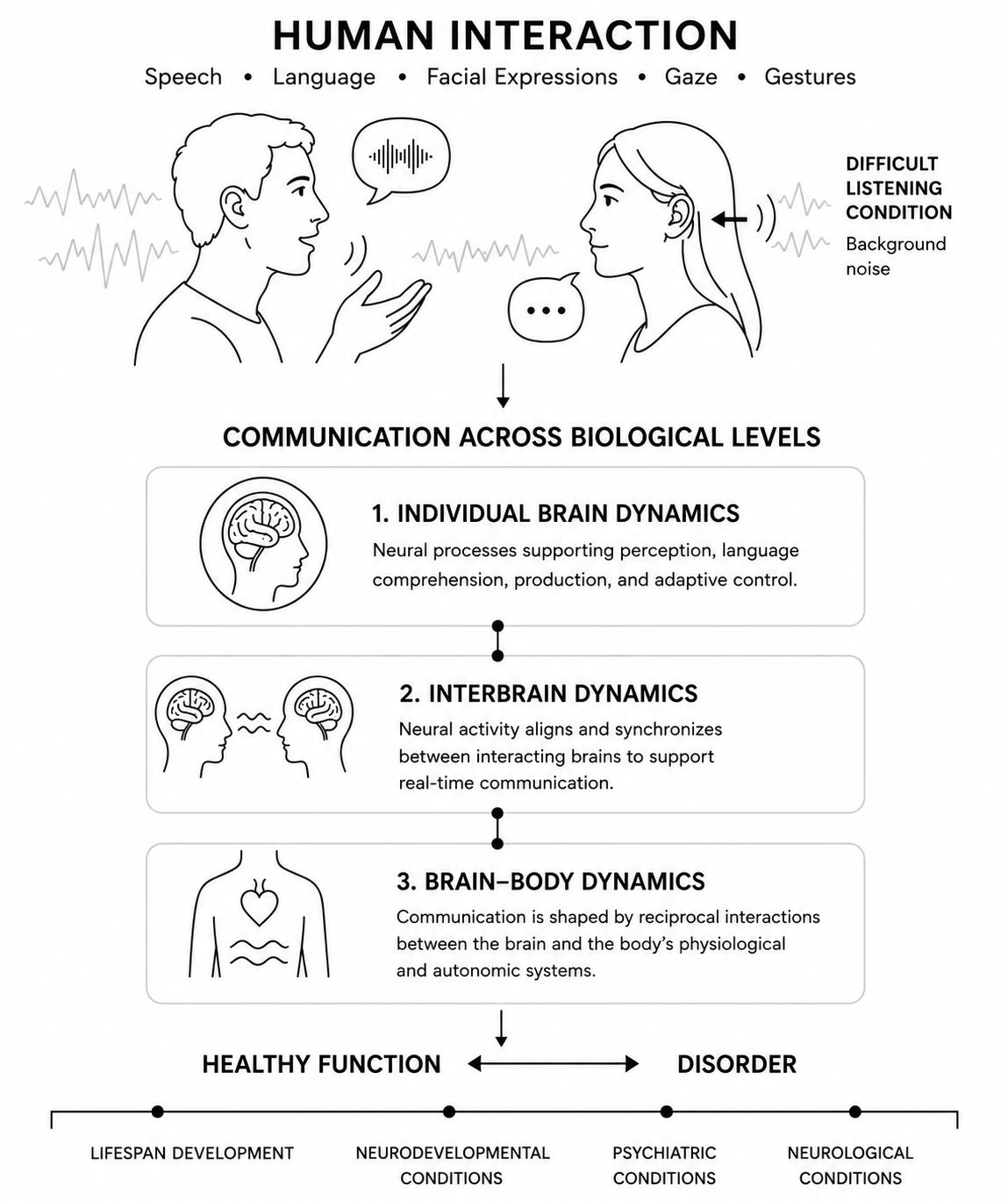
Our research framework is based on the premise that communication emerges from dynamic interactions across multiple neurobiological levels. We investigate how communication is represented and coordinated within the individual brain, how neural activity synchronizes between interacting brains, and how communication is shaped by reciprocal interactions between the brain and the body. Combining multimodal neuroimaging, behavioral experiments, computational modeling, and physiological measurements, we seek to uncover the mechanisms that support communication in health and how they are altered in neurodevelopmental, psychiatric, and neurological disorders.
Our research can be divided into three areas:
1. Understanding Human Communication
Mechanisms of communication within the brain, between brains, and between the brain and the body
We investigate how sensory, motor, cognitive, affective, and autonomic systems interact to enable speech, language, facial expressions, gaze, and other forms of human communication. Our research examines communication within individuals, between interacting brains, and through dynamic interactions between the brain and the body. By combining multimodal neuroscience, computational approaches, and experimental psychology, we aim to uncover the neurobiological mechanisms that enable adaptive human communication.
2. Communication across health and disease
Understanding communication across the lifespan, from healthy development to psychiatric and neurological disorders
Communication changes throughout life and is affected by sensory, neurodevelopmental, psychiatric, and neurological conditions. We investigate how alterations in brain dynamics contribute to communication difficulties across the lifespan, including hearing impairment, language disorders, autism spectrum disorder, ADHD, dementia, and other neurological conditions. Our goal is to identify objective neurobiological markers that improve understanding of communication disorders and support earlier diagnosis, individualized assessment, and precision medicine.
3. Translational neurotechnology
Transforming neuroscience into AI-driven diagnostics, biomarkers, and personalized interventions
We translate discoveries from communication neuroscience into innovative technologies for research and clinical practice. Our work combines artificial intelligence, computational speech and language analysis, immersive virtual reality, wearable sensors, hyperscanning, and closed-loop neurofeedback to develop next-generation diagnostic tools, digital biomarkers, and personalized interventions. Through collaborations with clinicians, engineers, and industry partners, we aim to create scalable technologies that improve communication, brain health, and quality of life.
Our research platform includes:
Neuroimaging
EEG • MRI
Human Interaction
Hyperscanning • Eye Tracking • Facial Expression Analysis • Behavioral Experiments
Brain–Body Physiology
Heart Rate Variability (HRV) • Electrocardiography (ECG) • Respiration
Speech & Language
Speech Acoustics • Speech & Language Analysis • Natural Language Processing
Computational Neuroscience
Machine Learning • Computational Modeling • Network Neuroscience • Neural Speech Tracking
Digital Technologies
Virtual Reality • Wearable Sensors • Mobile Technologies • Closed-loop Neurofeedback
Find more infos about our current research projects, here.